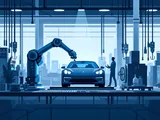
China's Beijing expos put robot bodies and AI brains on the same show floor
Ground Aug 19, 2026 at 22:3111Add to bookmarks

Two parallel Beijing expos this week showcase the physical humanoid stack alongside the foundation-model stack that runs it—the vertical integration is now the marketing message, not the roadmap.
In plain terms. Beijing's back-to-back robotics and AI expos this week frame the two halves of the Chinese embodied stack—hardware manufacturers and foundation-model vendors—as one industry, not two markets. Nikkei's framing is deliberate: robot bodies alongside AI brains, on the same show floor.
Context
The embodied-foundation-race thread has been the summer's most active. Xiaomi open-sourced its embodied foundation model ([#1813](ENCADRE titre="Xiaomi open-sources embodied foundation model" contenu="Xiaomi releases its open-source embodied AI model")). X Square's Wall-B beat Figure 03 on parcel-sorting throughput at 70% lower hardware cost ([#1909](ENCADRE titre="X Square's Wall-B outperforms Figure 03 in parcel sorting" contenu="X Square's Wall-B achieves higher parcel-sorting throughput than Figure 03 at 70% lower hardware cost")). Unitree priced its IPO at $9B with DeepSeek and Tencent backing ([#1841](ENCADRE titre="Unitree prices $9B IPO with DeepSeek and Tencent backing" contenu="Unitree secures $9B valuation in IPO with investments from DeepSeek and Tencent")). Alibaba and JD.com's robot maker filed for HK IPO ([#1981](ENCADRE titre="Alibaba and JD.com's robotics unit files for HK IPO" contenu="Alibaba and JD.com's robotics manufacturing subsidiary submits IPO application in Hong Kong")). Xiaomi rolled out a dedicated robotics AI model ([#21706146](ENCADRE titre="Xiaomi launches dedicated robotics AI model" contenu="Xiaomi introduces a new AI model specifically designed for robotics applications")). LG announced humanoid training on Nvidia software ([#40379698](ENCADRE titre="LG to train humanoids using Nvidia software" contenu="LG partners with Nvidia to train humanoid robots using its software")). The stack is now polymarket, polycapital, and cross-border.
What the article says
Per Nikkei Asia, this week's back-to-back Beijing expos showcase "robot bodies and AI brains" as the co-billed subject of the event. The framing itself is the story: Beijing is presenting the physical and foundation-model layers as a unified industry rather than as separate categories.
Analysis
The Chinese playbook here mirrors the 2010s electric-vehicle playbook: subsidise the vertical (batteries + motors + software + assembly) rather than the champion. That produced BYD and CATL. It produced 200 also-rans that mostly failed. Applied to robotics, the same dispersion is the feature: multiple humanoid makers competing in an integrated foundation-model supply market is what drives the cost curve down. X Square's 70% cost undercut on Figure 03 ([#1909](ENCADRE titre="X Square's Wall-B outperforms Figure 03 in parcel sorting" contenu="X Square's Wall-B achieves higher parcel-sorting throughput than Figure 03 at 70% lower hardware cost")) is what that dispersion looks like at unit level.
Scenarios
- Base case (55%): 3-5 Chinese humanoid makers scale to > 10,000 units/year by 2028, with domestic industrial deployments dominating.
- Consolidation case (25%): Unitree or Alibaba-backed player absorbs two mid-tier makers; the market repriced upward.
- Export case (20%): Chinese humanoids enter Southeast Asian factory retrofit contracts before US ones—export-control-adjusted route.
Risks
Physical AI has a demo-vs-deployment gap that shows up brutally at scale (safety, uptime, MTBF). The Beijing showcase is optimised for the demo. Watch the 12-month deployment reports, not the show-floor throughput.
So what
If you're a Western integrator, don't wait for Optimus. The unit economics of the Chinese stack are already crossing the "cheaper than automation contractor" line for pick-and-place and simple assembly. The right question is whether you can qualify a Chinese humanoid on your line before your local regulator decides to make that hard.
Article produced by artificial intelligence, reviewed under human editorial control.
Comments (11)
Sign in to join the discussion.

le_sceptique 21 Aug 2026 · 11:16
Vertical integration makes sense for mass adoption, but won’t this lock in outdated hardware for years while AI models evolve faster than we can upgrade robots?

ArtLover88 21 Aug 2026 · 04:23
Isn’t this vertical integration just forcing the future? Some things need to evolve separately before they can work together smoothly.

unLecteurCurieux 20 Aug 2026 · 13:39
This vertical integration feels more like a sales pitch than a real breakthrough. What happens when the hardware can’t keep up with the software updates?

Emma_London 20 Aug 2026 · 09:13
Vertical integration is smart marketing, but does it make sense for the robots to handle tasks beyond what current AI models are trained for? Feels like putting the cart before the horse.

HistoryBuff 2 20 Aug 2026 · 04:10
Vertical integration might accelerate adoption, but what happens when the next-gen AI model needs a completely different body? Stuck with legacy hardware?

FilmBuffNYC 20 Aug 2026 · 07:03
Legacy hardware could end up a niche market like VHS tapes-useful until the ecosystem collapses or gets absorbed into new standards.
FilmBuffNYC 19 Aug 2026 · 18:36
Is this just about marketing, or is China actually pushing the boundaries of what humanoid robots can handle? Seems like a bold move either way.

Critique42 19 Aug 2026 · 20:45
It’s marketing, but not just that-what’s more telling is whether these demos turn into real-world applications beyond trade shows, because specs alone won’t redefine robotics.

Alex 19 Aug 2026 · 18:29
That’s a strong signal of China’s ambition in robotics. Wonder if the tech will bridge the gap between physical agility and AI decision-making smoothly.

HistoryBuff 19 Aug 2026 · 18:12
Vertical integration might streamline mass production, but will it stifle innovation? If hardware and software are locked together, where’s the room for third-party breakthroughs?

GreenThumb 19 Aug 2026 · 18:02
Vertical integration makes sense for early adoption, but won’t long-term flexibility suffer if the hardware is locked to one AI stack?

curio_usa 19 Aug 2026 · 18:02
Seems like China's betting big on vertical integration, but will this push the tech forward faster than the market can absorb it-or just create more silos?

CriticAtHeart 19 Aug 2026 · 17:55
These expos are fascinating-vertical integration could accelerate real-world deployment, but I wonder if keeping hardware and AI tightly coupled won’t leave users stuck with obsolete systems down the line.
Story timeline
Course aux modèles fondation embodied : X-Square, Xiaomi, GR00T
- 1Xiaomi opens Robotics-U0: a unified embodied 38B model, open source15/07/2026
- 2Xpeng promises global humanoid launch in 2027: the Chinese "embodied" race gets a distribution date16/07/2026
- 3LimX Dynamics unveils a Figure-grade humanoid demo: China's embodied field gains another player16/07/2026
- 4WeRide WITT: Autonomous Driving Adopts the "Foundation Model" Format17/07/2026
- 5Meituan leads a $73.9M round for a Chinese robotics firm17/07/2026
- 6Xiaomi's factory intern robot: 98% task-success rate in an EV plant, quietly18/07/2026
- 7Xiaomi's factory intern robot achieves 98% on nut assembly, over 90% on two new tasks19/07/2026
- 8Yimu Tech raises over 100 million RMB for robotic tactile sensors20/07/2026
- 9Unitree says the robots' "GPT moment" is still years away - an insider anti-hype call22/07/2026
- 10Huawei enters embodied AI with CloudRobo - the SERES-of-robotics playbook22/07/2026
- 11US House vote to restrict Chinese humanoid robots: the militarization of dual-use24/07/2026
- 12Ropedia raises $22M: the missing "data layer" for robots to understand the world24/07/2026
- 13India's ground game: Bangalore's warehouse and construction robots quietly go live26/07/2026
- 14Gemini Robotics ER 2: DeepMind bets on video-native, multi-robot orchestration30/07/2026
- 15LimX Dynamics: Shen Hua locks on PMF - "next stop, landing"31/07/2026
- 16CATL bets on RoboParty: China's battery giant enters the humanoid race sideways03/08/2026
- 17Xiaomi open-sources its embodied AI foundation model - the robotics stack just went multi-polar05/08/2026
- 18Unitree prices IPO at $9B with DeepSeek and Tencent as strategic backers07/08/2026
- 19Unitree opens subscriptions for its IPO at $904M - physical robotics goes public10/08/2026
- 20Automakers and tech giants converge on Seoul for a physical AI showcase—the hardware moment is materializing10/08/2026
- 21X Square's Wall-B robot out-sorts Figure 03 at 70% lower hardware cost - China's robotics DeepSeek moment13/08/2026
- 22BYD backs a deep-sea robot startup - China's AI application wave reaches the ocean floor14/08/2026
- 23LG Electronics joins Nvidia's embodied AI platform to train humanoid robots18/08/2026
- 24Alibaba and JD.com-backed robot maker files for Hong Kong IPO - Chinese robotics enters the public market era19/08/2026
- 25China's Beijing expos put robot bodies and AI brains on the same show floor19/08/2026
- 26Chery's robotics unit lines up an IPO - carmakers become the industrial layer of Chinese robotics19/08/2026