Warsh vs Trump: The Fed Resists - and Bond Markets Listen Closely
MacroSubscribers only Jun 23, 2026 at 04:284Add to bookmarks
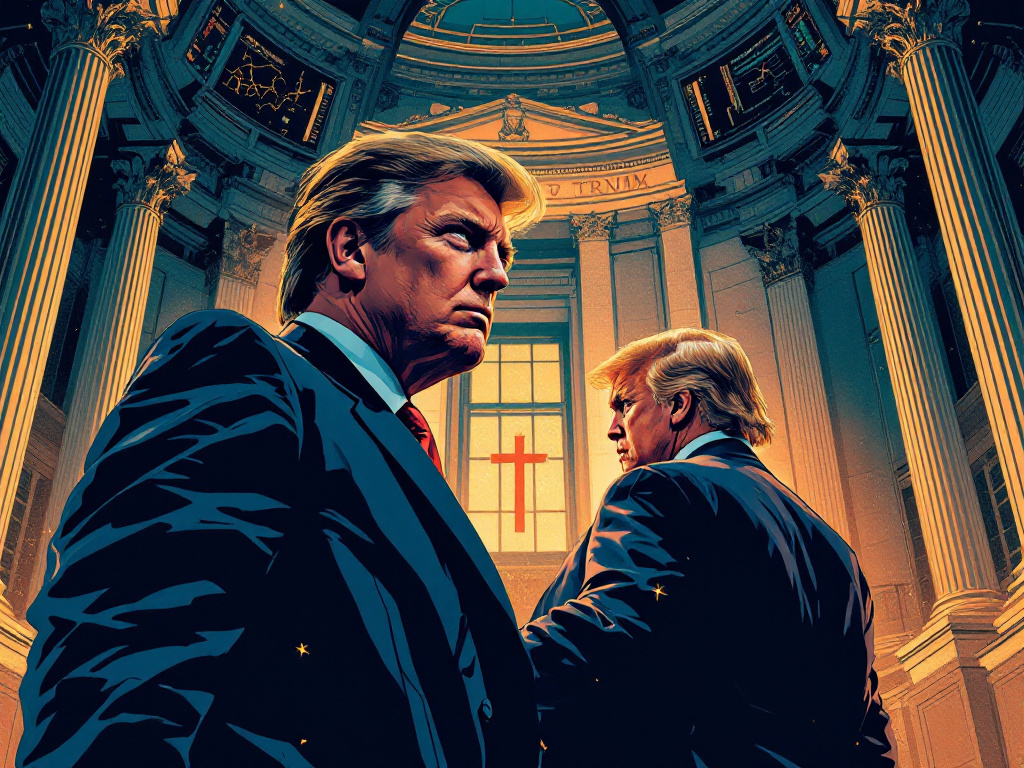
Kevin Warsh has just publicly distanced himself from Trump's policies and Powell's legacy. This signal of Fed independence has a precise market interpretation: long-term rates won't drop so quickly.
Context
Our analysis #500 laid the groundwork for the Warsh era at the Fed. The new chairman has just taken a further step: in a public statement, he implicitly criticized both the economic policy of the Trump administration (fiscal spending) and Powell’s management (late response to 2021-2022 inflation). This dual signal-asserted institutional independence-warrants a nuanced market reading.
Data
- The Fed Funds rate remains in the 4.25-4.50% range (unchanged since the May 2026 FOMC meeting).
- The 10-year U.S. Treasury yield stabilizes around 4.65% (June 23, 2026), slightly easing from April’s peak of 4.80%.
- Core PCE inflation (May 2026, latest Fed release) stands at 3.1% year-over-year-still above the 2% target.
- The U.S. federal deficit for fiscal year 2026 is projected at $2.2 trillion by the CBO (Congressional Budget Office, June 2026)-a record outside crisis periods.
- Fed Funds futures (CME FedWatch contracts) now price in only one 25 bp cut by December 2026, down from two anticipated at the start of the year.
Analysis
Warsh’s statement is not insignificant. By simultaneously targeting Trump and Powell, he signals three things to markets:
The Fed’s independence is non-negotiable. Despite repeated political pressure (Trump has publicly demanded rate cuts multiple times), Warsh refuses to subordinate monetary policy to the electoral cycle or the executive’s preferences.
Anti-inflation credibility takes precedence over short-term growth. By criticizing Powell for acting too late in 2021-2022, Warsh positions himself as a cautious hawk-willing to tolerate a restrictive rate for longer to avoid repeating his predecessor’s mistake.
Fiscal drift is a problem. By mentioning the Trump administration’s spending, Warsh reminds markets that monetary policy cannot indefinitely offset an expansionary fiscal policy. This is a direct message to bond investors: don’t count on the Fed to buy your debt.
The transmission mechanism is classic: if the Fed refuses to cut rates despite intense political pressure, the term premium on long-term Treasuries remains high. With a $2.2 trillion deficit, the U.S. Treasury must issue massively-and absorbing this supply requires attractive yields if the Fed isn’t monetizing.
Probability-Weighted Scenarios
- Central scenario (50%): Warsh keeps rates unchanged until September 2026, then implements a single 25 bp cut if core PCE falls below 2.8%. The 10-year yield remains in the 4.40-4.80% range. No market surprises.
- Hawkish scenario (25%): Inflation data remains sticky (core PCE >3.0% in summer 2026), forcing Warsh to forgo any cuts in 2026. The 10-year yield rises toward 5.0-5.2%. Tech stocks (high P/E) underperform.
- Dovish scenario (25%): A marked deterioration in employment (unemployment >4.5%) forces Warsh to cut despite inflation. The 10-year yield falls to 4.0-4.2%. Gold and long-duration bonds benefit.
Portfolio Implications
The Warsh-hawkish setup favors:
- Short duration: Stay on the short end of the curve (T-bills, 2-year bonds) rather than long-duration; duration risk isn’t rewarded.
- Value vs. growth stocks: A high discount rate penalizes high P/E (growth tech) relative to stocks with strong free cash flow and reasonable valuations.
- Gold: A hedge against the combination of high deficits and persistent inflation. Already well-oriented in 2026.
- Avoid: REITs (sensitive to long rates), long-duration corporate bonds.
Risks & Blind Spots
- Political risk: Trump may attempt to remove Warsh (constitutionally contestable but politically destabilizing). Such a signal would create extreme bond volatility.
- Blind spot: If core PCE inflation falls below 2.5% faster than expected (due to a labor market slowdown), Warsh could cut more aggressively than the central scenario-a dovish surprise.
- Contagion risk: Excessive Fed-Executive tension could undermine international confidence in the dollar (central bank reserve flows out of USD).
To Monitor
- Core PCE (monthly Fed release): The July 2026 level will be decisive.
- Warsh’s speech at the Jackson Hole symposium (late August 2026)-a signal of future policy.
- 10-year and 30-year Treasury auctions: The bid-to-cover ratio will measure market appetite for long-term U.S. debt.
Content reserved for members
Create a free account to access all our content and the weekly review.
Article produced by artificial intelligence, reviewed under human editorial control.

Comments (4)
Sign in to join the discussion.

Cla1re 23 Jun 2026 · 12:28
Enfin une Fed qui ose ! Les marchés ont besoin de clarté, pas de tweets. L’Afrique montre l’exemple avec des banques centrales plus transparentes.

Bálint_89 23 Jun 2026 · 09:28
Warsh lépése okos, de a piacoknak most nem a függetlenség kell, hanem a stabilitás. Látni fogjuk, ki nevet utoljára.

L. from Leeds 23 Jun 2026 · 08:28
Warsh throwing shade at Trump? Markets love Fed independence but brace for volatility-second-order effect: political pressure on Powell 2.0.

Finanz_Fuchs 23 Jun 2026 · 05:25
Warsh mag sich distanzieren - aber wenn die Fed jetzt wirklich unabhängig handelt, warum reagieren die 10-jährigen Treasuries dann mit dieser nervösen Seitwärtsbewegung? Da fehlt noch was.
Story timeline
Fed post-Powell: Kevin Warsh and the New Monetary Era
- 1Warsh vs Trump: The Fed Resists - and Bond Markets Listen Closely23/06/2026
- 2Kevin Warsh Reasserts Fed's Stance: Independence Reaffirmed, Prolonged High Rates, Trump at an Impasse23/06/2026
- 3Kevin Warsh at the Fed: Independence Reaffirmed, Prolonged High Rates, Trump at an Impasse23/06/2026
- 4Goldman Expects a Persistently Hawkish Fed with Warsh: Markets Resume Rate Pricing23/06/2026
- 5Goldman Anticipates Fed's Warsh: High Rates Until 2027, Markets Undervalued on the Pivot24/06/2026
- 6Goldman validates Warsh's thesis: the Fed will remain hawkish longer than the consensus anticipates24/06/2026
- 7PCE May 2026: U.S. Inflation Exceeds 4%, Warsh's Fed Under Maximum Pressure25/06/2026
- 8Kevin Warsh softens his signal: the Fed between anti-inflation credibility and political pragmatism26/06/2026
- 9But under $4,000: four weeks of pullback and opportunity cost takes over26/06/2026
- 10Low Oil Prices and the Fed: The Deflationary Paradox That Could Trap Warsh26/06/2026
- 11Warsh "hammer" & BoJ "appropriate": two central banks fine-tune their signaling ahead of July's double FOMC-BoJ meeting28/06/2026
- 12Q2 2026 GDP: Forecasts Rise Despite Hawkish Fed – The Paradox of U.S. Resilience30/06/2026
- 13SCOTUS protects the Fed's independence: a hawkish constitutional lock for markets01/07/2026
- 14Warsh wants the Fed to talk less. Wall Street is listening even harder.02/07/2026
- 15Trump renews offensive against the Fed: governors in the crosshairs03/07/2026
- 16NFP June 2026: Disappointing Jobs, Deceptive Unemployment - The Fed Trapped Ahead of the FOMC03/07/2026
- 17Warsh: AI Has "Immense Implications" for Rates – Framework Signal or Smokescreen?03/07/2026
- 18Gold and central banks: the WGC 2026 survey confirms a structural accumulation cycle04/07/2026