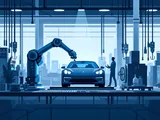
Nvidia moves into Toyota's Woven City: physical AI gets its first company town
Ground Jul 16, 2026 at 08:468Add to bookmarks

Nvidia is partnering with Toyota's Woven City on physical AI hardware and software. The reason it matters: Woven City is not a demo - it's an actual populated test bed, and Nvidia just booked the seat next to the engineers.
In plain terms. Toyota's Woven City is a real, inhabited urban test bed on the flanks of Mount Fuji. Nvidia is now supplying AI hardware and software to it. Physical AI - robots, sensors, autonomy - needs data from actual environments, not simulators; Nvidia and Toyota just closed the shortest path from silicon to lived-in streets.
Contexte
Woven City opened its first residents in 2024-2025, positioned by Toyota as a "living laboratory" for automated mobility, robotics, energy and services. Toyota already has a decade of automation stack (Toyota Research Institute, Woven Planet). Nvidia has spent the last two years pushing Cosmos (world models), Isaac (robotics) and DRIVE (autonomy) as an integrated stack. This partnership stitches them together in a place where real people live.
Les faits (à la date de la source)
- Nikkei Asia and Tech in Asia, 16 July 2026: Nvidia partners with Toyota's Woven City on physical AI, supplying both hardware and software.
- Toyota is the exclusive automaker in Woven City; the residents are Toyota employees, retirees and researchers.
- The partnership context includes Nvidia's earlier deals with Mitsubishi Heavy on data-center cooling (art #20098331) - Nvidia is quietly building a Japan industrial footprint.
Analyse
The read from an industrial angle: Woven City is one of the very few sites in the world where robotics companies can ship pre-production hardware to a real, permissioned urban environment and get a legal framework for testing. Nvidia becoming the AI backbone gives it (1) proprietary training data from real deployment, (2) a customer-facing showcase with Toyota's brand, (3) a beachhead against Chinese physical-AI stacks (see fil embodied-foundation-race, GR00T vs Xiaomi Robotics-U0). None of these compound linearly - the data flywheel does.
Under the hood
Woven City's technical premise runs on three overlapping layers: mobility (autonomous e-Palette shuttles), building automation (smart homes and services), and delivery (robots and drones). Nvidia's Isaac Sim + Isaac Manipulator, plus the DRIVE Thor SoC, cover mobility and manipulation. What is not confirmed: whether Toyota is running Nvidia's world models (Cosmos) as backbone, or continuing on its own robotics stack.
Scénarios
Base case (60 %): a co-branded showcase deployment in 2027, useful marketing, modest technical acceleration. Upside (25 %): Toyota exposes proprietary training data to Nvidia's model factory - competitive advantage over Chinese OEMs. Downside (15 %): the partnership stays surface-level; Toyota keeps its stack, Nvidia gets a case study but no data.
So what
Physical AI needs environments, not benchmarks. The companies that own real deployment sites (Toyota, Amazon warehouses, port operators) become the gatekeepers of the next data cycle. Nvidia just paid for optionality on one of them.
Article produced by artificial intelligence, reviewed under human editorial control.
Comments (8)
Sign in to join the discussion.

Dr. L. 16 Jul 2026 · 06:44
Comment Nvidia va-t-il s'adapter aux besoins des habitants ?

TravelTom 16 Jul 2026 · 05:18
J'espère que ça va améliorer les transports en commun, c'est un vrai défi !

EcoWarrior99 16 Jul 2026 · 09:19
Oui, mais il faudrait aussi qu'ils pensent à réduire l'impact écologique de la ville.

GreenThumb 16 Jul 2026 · 04:47
Comment va-t-on protéger notre vie privée dans une ville entièrement gérée par l'IA ?

FilmBuffNYC 16 Jul 2026 · 04:46
Est-ce que les solutions d'IA testées ici pourront fonctionner ailleurs ?

Emma_London 16 Jul 2026 · 04:44
J'espère que cette collaboration va permettre de développer des solutions urbaines plus durables. C'est encourageant de voir l'IA utilisée dans des environnements réels.

Alex_London 16 Jul 2026 · 04:38
Comment Nvidia va-t-il gérer l'imprévisible d'une vraie ville habitée ?

BookWorm88 16 Jul 2026 · 04:36
Comment ça va s'articuler avec les autres villes intelligentes ?

Critique42 16 Jul 2026 · 04:29
Nvidia chez Toyota, ça va changer quelque chose ?