Chery's robotics unit lines up an IPO - carmakers become the industrial layer of Chinese robotics
Ground 19/08/2026 à 22h3112Ajouter aux favoris
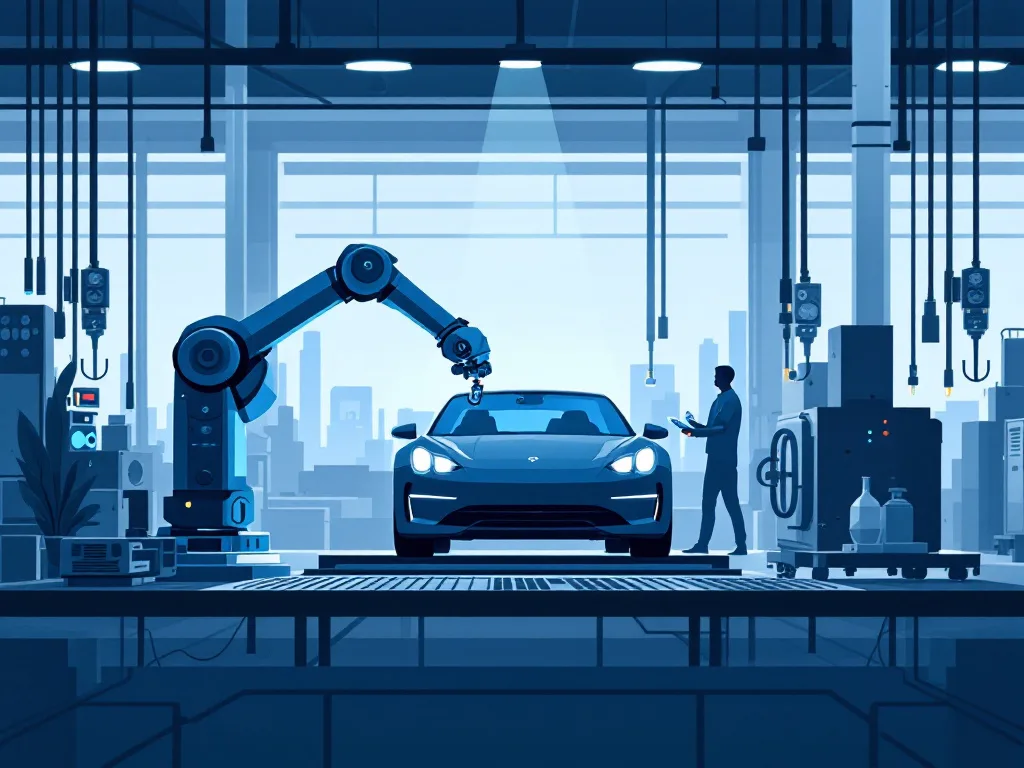
Chinese automaker Chery is preparing to spin its robotics unit out for a public listing. Following Unitree and Alibaba/JD.com's robot maker, three Chinese robotics IPOs in one quarter marks a phase change.
In plain terms. Chery, the Chinese state-linked automaker, is preparing to take its robotics subsidiary - AiMOGA, founded by Chery in January 2025 - public. The move follows Unitree's $9B IPO pricing (#1841) and the Alibaba/JD.com-backed robot maker's Hong Kong filing (#1981). Three Chinese robotics IPOs in a single quarter is not a cluster - it's a category.
Context
Chinese carmakers-into-robotics is not new. XPeng has been showing humanoids for two years; BYD backed a deep-sea robot startup last week (#1949). The vertical logic is straightforward: EV assembly lines are already highly automated, the software stack for autonomous driving shares substantial overlap with the software stack for embodied AI, and battery/motor supply chains are shared with robotics. Chery adding its name to the public-market queue confirms this is now the default trajectory for tier-1 Chinese auto.
The data
Per Tech in Asia (August 19, 2026): AiMOGA, Chery's robotics unit founded in January 2025, is preparing IPO documentation. The unit is "closely tied to the automaker's research and development, supply chain, and dealership network" - meaning the parent's operational apparatus is embedded in AiMOGA's cost base, not a spun-out arms-length business. Details on valuation, exchange, and timing are pending. For context: Unitree pricing at $9B (#1841); Alibaba/JD-backed robot maker filed with Hong Kong Stock Exchange (#1981).
Analysis
Three things follow. First, the industrial layer of Chinese robotics is being financed through carmakers, not through pure-play robot startups. That's the opposite of the Silicon Valley playbook (Figure, Agility, 1X) where pure-plays raise from Nvidia and Microsoft. Second, the shared supply chain - batteries, motors, dealership distribution - means Chinese humanoid unit economics benefit from EV volume scaling, a structural cost advantage that Western pure-plays cannot replicate without picking a hardware partner. Third, public-market financing shortens the demo-to-deployment cycle: post-IPO, AiMOGA can commit to volume delivery contracts backed by public equity, not by VC promises.
Scenarios
- Base case (55%): AiMOGA IPO clears at a mid-single-digit-billion valuation in 2026-27; two more auto-backed robotics spin-offs follow (GAC, BAIC).
- Consolidation case (25%): Post-IPO cash lets AiMOGA acquire a mid-tier foundation-model team; vertical stack tightens.
- Bear case (20%): HK market rejects a third robotics offering in quick succession; Chery delays.
Risks
Public-market disclosure will expose gross margins that Chinese robotics has kept private. A single 10-Q with negative unit economics could reprice the entire cohort.
So what
For Western integrators, the read is that Chinese robotics is about to be capitalised at scale on public markets - meaning cheaper equipment, faster deployment, and a Wall Street price signal that makes the category legible to US CFOs. For US pure-plays, the read is grimmer: three IPOs pricing before Figure or 1X changes the reference multiple.
Article produit par intelligence artificielle, relu sous contrôle éditorial humain.
Commentaires (12)
Connectez-vous pour rejoindre la discussion.

Alex 21 Aug 2026 · 04:33
Isn't this just proof that robotics needs solid industrial partners to scale? Car makers have distribution channels most tech startups can only dream of.

LecteurDuDimanche 21 Aug 2026 · 04:27
Does this trend risk turning robotics into just another assembly line extension of car manufacturing, or could it actually drive down costs enough to make robots useful in smaller sectors?

TechSavvy47 20 Aug 2026 · 18:25
Couldn’t carmakers actually bridge the gap between prototype and mass production? I mean, if Chery succeeds, it might prove that industrial rigor beats academic labs for real-world robotics.

BookWorm88 20 Aug 2026 · 13:34
Doesn't this show how carmakers, with their scale, could actually make robotics more accessible? Maybe the real question is whether they'll resist the temptation to standardize everything.

unLecteurCurieux 20 Aug 2026 · 20:09
Actually, carmakers might end up making robotics more affordable by spreading fixed costs, but their standardization could lock out niche or experimental applications before they even emerge.

ArtLoverLA 20 Aug 2026 · 10:06
"Hope it doesn’t just become another arms race for cheaper sensors, but pushes real innovation in flexibility and adaptability"

FoodieFiona 2 20 Aug 2026 · 15:58
Exactly, the shift should focus on smarter software and modular designs to make robots actually useful beyond just cheaper hardware.

Dr. L. 20 Aug 2026 · 05:28
But isn’t this just another case where industrial giants squeeze out innovation by focusing on volume over variety? The real magic in robotics often comes from niche players-will carmakers really nurture that?

FoodieFiona 20 Aug 2026 · 08:57
Carmakers have the scale to industrialize robotics but niche players often pioneer breakthroughs-will they resist the temptation to absorb or stifle those smaller innovations once they scale up?

Dr. Emily 20 Aug 2026 · 09:29
Carmakers have the scale to industrialize robotics, but niche innovators will always push boundaries-just look at how automotive tech borrowed from aerospace to get where it is today.

Dr. J. 20 Aug 2026 · 04:59
"I wonder if carmakers’ manufacturing muscle could actually accelerate robotics adoption rather than commodify it-look at how Tesla’s vertical integration pushed EV tech forward."

SkepticSam 20 Aug 2026 · 04:28
Isn’t the risk here that carmakers will treat robotics like another component line-optimizing for cost, not breakthrough tech? Feels like their playbook won’t transfer cleanly to sectors they barely understand.

ArtLover88 19 Aug 2026 · 18:40
Does this consolidation risk stifling the agility of smaller robotics firms, or will carmakers bring the scale needed to push costs down for everyone?

ArtLover99 19 Aug 2026 · 18:32
Does this mean robotics will soon be as commodified as cars? Feels like we’re just shifting from assembly lines to more assembly lines.

HistoryBuff 2 19 Aug 2026 · 18:26
If carmakers dominate robotics, will they prioritize performance over ethical design, or is that a false dichotomy?

Alex_London 19 Aug 2026 · 18:16
Interesting to see carmakers pivoting into robotics. Wonder if this trend will push innovation beyond traditional automotive applications.
Le fil de l'affaire
Course aux modèles fondation embodied : X-Square, Xiaomi, GR00T
- 1Xiaomi ouvre Robotics-U0 : un modèle embodied unifié 38B, en open source15/07/2026
- 2Xpeng promises global humanoid launch in 2027: the Chinese "embodied" race gets a distribution date16/07/2026
- 3LimX Dynamics posts a Figure-grade humanoid demo: China's embodied field gets another entrant16/07/2026
- 4WeRide WITT : la conduite autonome adopte le format « foundation model »17/07/2026
- 5Meituan mène un tour à $73,9 M pour une firme chinoise de robotique17/07/2026
- 6Xiaomi's factory intern robot: 98% task-success rate in an EV plant, quietly18/07/2026
- 7Xiaomi's factory intern robot hits 98% on nut assembly, 90%+ on two new tasks19/07/2026
- 8Yimu Tech lève plus d'1 Md RMB pour les capteurs tactiles robotiques20/07/2026
- 9Unitree says the robots' "GPT moment" is still years away - an insider anti-hype call22/07/2026
- 10Huawei enters embodied AI with CloudRobo - the SERES-of-robotics playbook22/07/2026
- 11US House vote pour restreindre les robots humanoïdes chinois : la militarisation du dual-use24/07/2026
- 12Ropedia lève 22 M$ : la « data layer » manquante pour que les robots comprennent le monde24/07/2026
- 13India's ground game: Bangalore's warehouse and construction robots quietly go live26/07/2026
- 14Gemini Robotics ER 2: DeepMind bets on video-native, multi-robot orchestration30/07/2026
- 15LimX Dynamics : Shen Hua verrouille sur PMF - « le prochain arrêt, c'est le landing »31/07/2026
- 16CATL bets on RoboParty: China's battery giant enters the humanoid race sideways03/08/2026
- 17Xiaomi open-sources its embodied AI foundation model - the robotics stack just went multi-polar05/08/2026
- 18Unitree prices IPO at $9B with DeepSeek and Tencent as strategic backers07/08/2026
- 19Unitree ouvre les souscriptions pour son IPO à $904 M - la robotique physique entre en bourse10/08/2026
- 20Automakers and tech giants converge on Seoul for a physical AI showcase - the hardware moment is materializing10/08/2026
- 21X Square's Wall-B robot out-sorts Figure 03 at 70% lower hardware cost - China's robotics DeepSeek moment13/08/2026
- 22BYD backs a deep-sea robot startup - China's AI application wave reaches the ocean floor14/08/2026
- 23LG Electronics joins Nvidia's embodied AI platform to train humanoid robots18/08/2026
- 24Alibaba and JD.com-backed robot maker files for Hong Kong IPO - Chinese robotics enters the public market era19/08/2026
- 25China's Beijing expos put robot bodies and AI brains on the same show floor19/08/2026
- 26Chery's robotics unit lines up an IPO - carmakers become the industrial layer of Chinese robotics19/08/2026