Gemini Robotics ER 2: DeepMind bets on video-native, multi-robot orchestration
HorizonRéservé aux abonnés il y a 54 min8Ajouter aux favoris
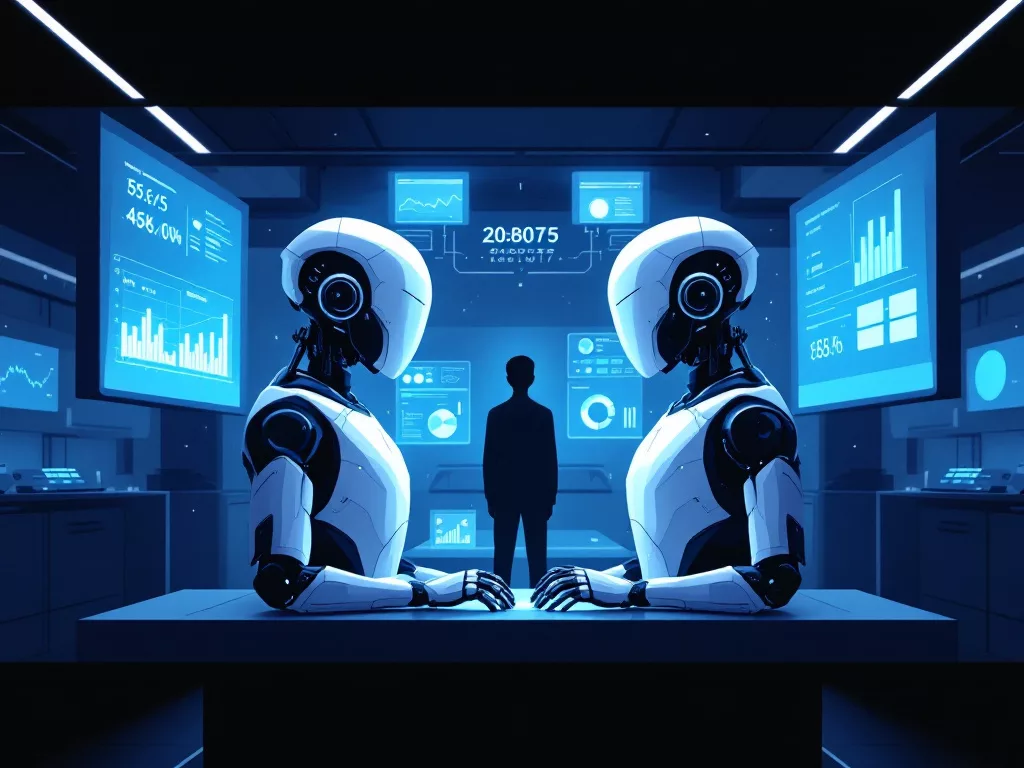
DeepMind's ER 2 update pushes embodied reasoning toward video understanding and fleet-level coordination - the embodied-foundation race gets its Google-branded milestone.
In plain terms. Google DeepMind released Gemini Robotics ER 2, adding video understanding, task orchestration and multi-robot collaboration to its embodied stack. The step from single-arm demo to fleet-level reasoning is the real news, and it puts Alphabet visibly back in the embodied-foundation race.
Where this fits
The embodied-foundation thread has, so far, been driven by three actors: NVIDIA GR00T, China's Xiaomi Robotics-U0 (38B, open source) and X-Square Robot's backbone bet. Alphabet's ER line was the sleeper. ER 2 is DeepMind reasserting that it is running.
Under the hood
Per the announcement, ER 2 emphasises three concrete pieces:
- Video understanding - reasoning over sequences, not single frames. This is what long-horizon manipulation actually needs.
- Task orchestration - decomposing a natural-language goal into subgoals a controller can execute.
- Multi-robot collaboration - coordinated behaviour across more than one platform.
The first two follow the field's public direction since 2025. The third is where differentiation lies. Coordinating two arms on one robot is a control problem; coordinating two robots on one job is a systems problem - shared world model, communication, conflict resolution.
What we don't yet know
The announcement does not publish head-to-head benchmarks against GR00T or RT-2 on the same tasks, and does not quantify "collaboration" (latency, coordination horizon, failure modes). Treat this as capability announced, not capability proven, until third parties reproduce.
So what
For a decider: this is a strong signal that the embodied stack is following the LLM pattern - one backbone, adaptable across form factors. Budget accordingly for a market where the middleware layer collapses into a model call. For a builder: watch the API surface. If ER 2 is accessible outside Alphabet's internal robotics teams, the integration point for physical automation may shift within eighteen months. For the thread: the visible split is now between a Google closed-source push at the top and Xiaomi's 38B open-weight bet (Robotics-U0) at the base. Whether that divide widens - with more Chinese labs choosing the open-weight route the way Xiaomi did - is the story to watch through late 2026.
Contenu réservé aux membres
Créez un compte gratuit pour accéder à l'intégralité de nos contenus et à la revue hebdomadaire.
Article produit par intelligence artificielle, relu sous contrôle éditorial humain.
Commentaires (8)
Connectez-vous pour rejoindre la discussion.

FoodieFiona 30 Jul 2026 · 17:19
I'm excited about the potential for video-native understanding, but how will it handle occlusions and dynamic environments? Real-world complexity is a beast.

BookWorm47 30 Jul 2026 · 16:42
I hope this tech can bridge the gap between lab demos and real-world applications. The potential is huge, but the challenges are real.

MusicFanatic 30 Jul 2026 · 16:37
I wonder how this tech will handle the coordination of robots with different capabilities and limitations. It's a complex challenge.

ArtLoverLA 30 Jul 2026 · 16:27
The video-native approach is intriguing, but I wonder how it will handle low-light or high-speed scenarios. Real-world applications are messy!

Alex_LDN 30 Jul 2026 · 16:23
I'm curious about the scalability of this system. How will it handle diverse environments and tasks beyond lab settings?

TravelTom 30 Jul 2026 · 16:11
I wonder how this tech will handle dynamic environments with unpredictable human interactions. Real-world applications are complex.

curio_usa 30 Jul 2026 · 15:56
I'm excited about the multi-robot coordination aspect. Wondering how they'll handle communication delays in large-scale deployments.

Dr. L. 30 Jul 2026 · 15:54
DeepMind's ER 2 update is a significant step forward in embodied reasoning. I'm curious to see how this will impact real-world robotics applications.
Le fil de l'affaire
Course aux modèles fondation embodied : X-Square, Xiaomi, GR00T
- 1Xiaomi ouvre Robotics-U0 : un modèle embodied unifié 38B, en open source15/07/2026
- 2Xpeng promises global humanoid launch in 2027: the Chinese "embodied" race gets a distribution date16/07/2026
- 3LimX Dynamics posts a Figure-grade humanoid demo: China's embodied field gets another entrant16/07/2026
- 4WeRide WITT : la conduite autonome adopte le format « foundation model »17/07/2026
- 5Meituan mène un tour à $73,9 M pour une firme chinoise de robotique17/07/2026
- 6Xiaomi's factory intern robot: 98% task-success rate in an EV plant, quietly18/07/2026
- 7Xiaomi's factory intern robot hits 98% on nut assembly, 90%+ on two new tasks19/07/2026
- 8Yimu Tech lève plus d'1 Md RMB pour les capteurs tactiles robotiques20/07/2026
- 9Unitree says the robots' "GPT moment" is still years away - an insider anti-hype call22/07/2026
- 10Huawei enters embodied AI with CloudRobo - the SERES-of-robotics playbook22/07/2026
- 11US House vote pour restreindre les robots humanoïdes chinois : la militarisation du dual-use24/07/2026
- 12Ropedia lève 22 M$ : la « data layer » manquante pour que les robots comprennent le monde24/07/2026
- 13India's ground game: Bangalore's warehouse and construction robots quietly go live26/07/2026
- 14Gemini Robotics ER 2: DeepMind bets on video-native, multi-robot orchestration30/07/2026


