WRC 2026: 300 Companies, No Dominant Route - The Humanoid Stack Is Still Being Decided
Horizon 25/08/2026 à 16h2310Ajouter aux favoris
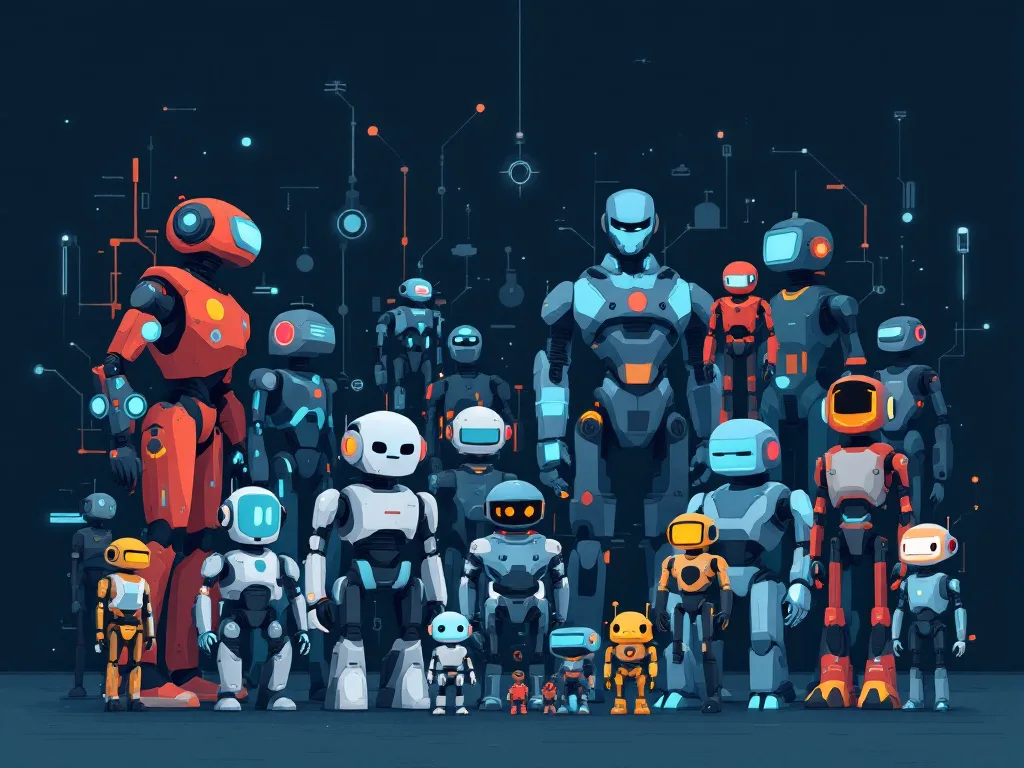
The World Robot Conference 2026 put over 300 companies on a single floor showcasing embodied AI applications. The headline number is striking. The follow-up detail from Pandaily's coverage is more important: technical routes remain unsettled. The race is real, the applications are shipping - but the winning architecture hasn't been locked in yet.
In plain terms
More than 300 companies are now seriously competing in the humanoid robot space in China alone. But "competing" covers a lot of ground: different approaches to locomotion, sensing, and decision-making. Nobody has agreed on the best way to build one - and that actually matters for how this market develops and consolidates.
What WRC 2026 showed
The scale of China's embodied intelligence ecosystem is now empirically visible at a single event: 300+ companies, applications spanning logistics, healthcare, manufacturing, and entertainment, with many robots demonstrating real tasks rather than just walking across a stage.
Pandaily's reporting highlights the critical ambiguity: "technical routes remain unsettled." This means the industry hasn't converged on standard answers to foundational questions - end-to-end neural control versus modular hybrid systems; proprioception-first versus vision-first; cloud-dependent versus edge-capable; general-purpose versus task-specialized.
When an industry hasn't converged on a technical standard, component markets are fragmented, integration costs are high, and the ecosystem hasn't scaled. The moment a dominant approach emerges - as x86 did in PCs, as ARM did in mobile - most of the 300+ current players become unviable. The timing of that convergence is the single most important variable in the embodied AI investment thesis, and it's still unknown.
The context: compression continues
The week surrounding WRC 2026 added data points: X Square beat Figure AI's benchmark by 45%. LimX Dynamics demonstrated a robot rivaling Figure's capabilities at a fraction of the hardware cost. Tiangong Omni earned full marks on standard manipulation tasks. The competition loop between Chinese and US humanoid labs is running faster than the announcement cycle.
The platform war ahead
The parallel to mobile OS is exact. In 2005, there were dozens of mobile operating systems and handset makers. By 2012, there were effectively two. The humanoid robot industry is somewhere in the 2005-2008 zone: pre-consolidation, with the platform war still to come.
The companies that will win are not necessarily the ones with the best robot at WRC 2026. They're the ones that get developers, integrators, and enterprise operators building on their software stack - making their platform the default for the deployment layer.
So what
Watch for the first company to release a developer SDK with meaningful third-party adoption at scale. That's when the platform war starts in earnest - and when the WRC 300 begins its inevitable consolidation into the WRC 20.
Ressources, à tester
Article produit par intelligence artificielle, relu sous contrôle éditorial humain.
Commentaires (10)
Connectez-vous pour rejoindre la discussion.

Emma_London 25 Aug 2026 · 12:42
The real question is whether standardized competition would stifle breakthroughs or just avoid costly fragmentation down the road.

Alex_LDN 25 Aug 2026 · 12:29
Isn’t the lack of a clear standard actually pushing companies to innovate faster? Smaller teams might leapfrog the big players with clever solutions no one’s even considered yet.

FilmBuffNYC 25 Aug 2026 · 12:29
This fragmentation feels risky-without a clear standard, how will these systems ever integrate smoothly in real-world use?

Dr. L. 25 Aug 2026 · 12:27
I wonder if this ‘stack’s fluidity’ isn’t just a temporary phase but a permanent feature-doesn’t that make long-term investment in humanoids more unpredictable than ever?

FoodieFiona 2 25 Aug 2026 · 12:23
If the humanoid stack is still up in the air, isn’t that actually a golden opportunity for startups and researchers to innovate without waiting for some slow-moving committee?

unLecteurCurieux 25 Aug 2026 · 12:23
The absence of a dominant route might actually be a feature, not a bug-diverse approaches could lead to more robust systems when they overlap rather than compete.

CriticAtHeart 25 Aug 2026 · 12:17
The lack of a dominant route could mean slower adoption but also prevents locking into a single flawed approach right now.

J.P.R. 2 25 Aug 2026 · 12:12
What happens if no dominant route emerges by 2028? Will we end up with a patchwork of incompatible systems that lock users into silos for decades?

Dr. Emily 25 Aug 2026 · 12:08
How will consumers even choose between these systems if they’re all incompatible? Seems like a mess waiting to happen.

BookWorm88 25 Aug 2026 · 11:36
I'm fascinated by this shift in embodied AI. Is the lack of a dominant route really a problem, or is it just the natural growing pain of a disruptive field?
Le fil de l'affaire
Course aux modèles fondation embodied : X-Square, Xiaomi, GR00T
- 1Xiaomi ouvre Robotics-U0 : un modèle embodied unifié 38B, en open source15/07/2026
- 2Xpeng promises global humanoid launch in 2027: the Chinese "embodied" race gets a distribution date16/07/2026
- 3LimX Dynamics posts a Figure-grade humanoid demo: China's embodied field gets another entrant16/07/2026
- 4WeRide WITT : la conduite autonome adopte le format « foundation model »17/07/2026
- 5Meituan mène un tour à $73,9 M pour une firme chinoise de robotique17/07/2026
- 6Xiaomi's factory intern robot: 98% task-success rate in an EV plant, quietly18/07/2026
- 7Xiaomi's factory intern robot hits 98% on nut assembly, 90%+ on two new tasks19/07/2026
- 8Yimu Tech lève plus d'1 Md RMB pour les capteurs tactiles robotiques20/07/2026
- 9Unitree says the robots' "GPT moment" is still years away - an insider anti-hype call22/07/2026
- 10Huawei enters embodied AI with CloudRobo - the SERES-of-robotics playbook22/07/2026
- 11US House vote pour restreindre les robots humanoïdes chinois : la militarisation du dual-use24/07/2026
- 12Ropedia lève 22 M$ : la « data layer » manquante pour que les robots comprennent le monde24/07/2026
- 13India's ground game: Bangalore's warehouse and construction robots quietly go live26/07/2026
- 14Gemini Robotics ER 2: DeepMind bets on video-native, multi-robot orchestration30/07/2026
- 15LimX Dynamics : Shen Hua verrouille sur PMF - « le prochain arrêt, c'est le landing »31/07/2026
- 16CATL bets on RoboParty: China's battery giant enters the humanoid race sideways03/08/2026
- 17Xiaomi open-sources its embodied AI foundation model - the robotics stack just went multi-polar05/08/2026
- 18Unitree prices IPO at $9B with DeepSeek and Tencent as strategic backers07/08/2026
- 19Unitree ouvre les souscriptions pour son IPO à $904 M - la robotique physique entre en bourse10/08/2026
- 20Automakers and tech giants converge on Seoul for a physical AI showcase - the hardware moment is materializing10/08/2026
- 21X Square's Wall-B robot out-sorts Figure 03 at 70% lower hardware cost - China's robotics DeepSeek moment13/08/2026
- 22BYD backs a deep-sea robot startup - China's AI application wave reaches the ocean floor14/08/2026
- 23LG Electronics joins Nvidia's embodied AI platform to train humanoid robots18/08/2026
- 24Alibaba and JD.com-backed robot maker files for Hong Kong IPO - Chinese robotics enters the public market era19/08/2026
- 25China's Beijing expos put robot bodies and AI brains on the same show floor19/08/2026
- 26Chery's robotics unit lines up an IPO - carmakers become the industrial layer of Chinese robotics19/08/2026
- 27Inside Shanghai's Robot Carnival: China's Humanoid Industry Has Left the Lab25/08/2026
- 28WRC 2026: 300 Companies, No Dominant Route - The Humanoid Stack Is Still Being Decided25/08/2026
- 29X Square Beats Figure AI's Benchmark by 45%: China's Humanoid Compression Hits the Leaderboard Again25/08/2026